Key Takeaways:
- Larger photovoltaic installations in Germany generally require a formal glare assessment report (Blendgutachten) before approval under the Bundes-Immissionsschutzgesetz (BImSchG, Germany's federal immission control law)
- The LAI guidelines set the de facto thresholds: roughly 30 hours of cumulative glare per year and 30 minutes per day to any single observer
- An assessment must identify affected observers (residential windows, road users, aircraft pilots), compute reflected sun directions across the full calendar year, and account for terrain and buildings that obstruct rays
- Static 2D diagrams and tables are no longer sufficient for non-trivial sites — planners and neighbours increasingly expect interactive 3D visualisations alongside the numerical results
- A modern glare assessment report combines ray-traced physics with a clear PDF deliverable that planning officers can read without expert interpretation
What the BImSchG Requires
The Bundes-Immissionsschutzgesetz (BImSchG) is Germany's federal immission control law. It regulates emissions of substances, noise, vibration, light, heat, and radiation that may cause harm or significant nuisance to people, animals, plants, or property.
Solar glare — the bright reflection of sunlight off photovoltaic (PV) panels — falls squarely under "light immissions" (Lichtimmissionen in the German text). When a PV installation is large enough to be relevant under BImSchG, the operator must demonstrate that its glare impact on neighbouring observers stays within accepted limits.
The law itself does not define numerical glare thresholds. Those come from the LAI (Länderausschuss für Immissionsschutz, the joint working group of Germany's state immission control authorities). Their guidance document, Guidelines on the Measurement, Assessment and Reduction of Light Immissions (German: Hinweise zur Messung, Beurteilung und Minderung von Lichtimmissionen), establishes the practical standard that planning authorities apply across the federal states.
The two most cited LAI thresholds for PV glare:
- No more than ~30 hours of cumulative glare per calendar year to any single observer
- No more than ~30 minutes of glare per day at any single observer
When a proposed installation would exceed these limits, mitigation is required — typically by adjusting panel tilt, azimuth, height, or by adding screening — and the assessment must be re-run.
Who Needs a Glare Assessment
Not every rooftop PV system triggers a formal glare assessment, but the threshold for needing one is lower than many operators expect. In practice, an assessment is required (or strongly recommended) when:
- The installation is part of a building permit application (Bauantrag) for a building or ground-mounted PV system above the size threshold that is exempt from formal approval
- The site is adjacent to residential buildings, roads, or railway lines
- The site is within sightline of an airfield or controlled airspace (where aviation authorities have additional requirements)
- A neighbour or local authority raises a formal objection during the planning process
Even where not strictly required, project developers increasingly commission an assessment preemptively. The cost of a study is small compared to the delay caused by a planning objection partway through a project.
What a Compliant Assessment Must Show
The assessment report is a technical document, but it is read by planning officers and sometimes by neighbours — people who are not solar engineers. A complete report should answer four questions clearly:
1. Where exactly is the installation? Geographic coordinates of the site, the precise position and orientation of each panel array, and a clear map showing the immediate surroundings.
2. Who are the affected observers? Every observer point that could plausibly be exposed to reflected sunlight: residential window positions (typically at 1.6 m height per LAI guidance), road segments at driver eye level, and aviation observer points for airfield-adjacent sites.
3. When does glare occur at each observer? For every observer, a year-long simulation of when reflected sunlight would reach them — accounting for the sun's path, panel reflectivity, and any terrain or buildings that block the rays. The result is a table or chart of glare events: which days, which times, how long, and how intense.
4. Does the result stay within the LAI thresholds? A clear pass/fail statement per observer, alongside the aggregate hours-per-year and minutes-per-day numbers.
If any observer exceeds the threshold, the report must propose mitigation and either demonstrate that the mitigated design passes or recommend further changes.
The 3D Approach
The technical methodology for computing glare has been understood for decades — it is fundamentally a ray-tracing problem. From every panel surface, cast a ray toward each observer point, reflect it according to the panel's optical properties, and check whether the reflected direction matches one of the sun's known positions across the year.
What has changed is how the result is presented.
Until recently, most glare assessment reports were delivered as PDFs full of static 2D plots, top-down site maps, and time-series tables. The data was correct, but it was hard for non-technical stakeholders to evaluate. A neighbour reviewing the document had to take the numbers on faith. A planning officer had to trust that the consultant had set up the geometry correctly.
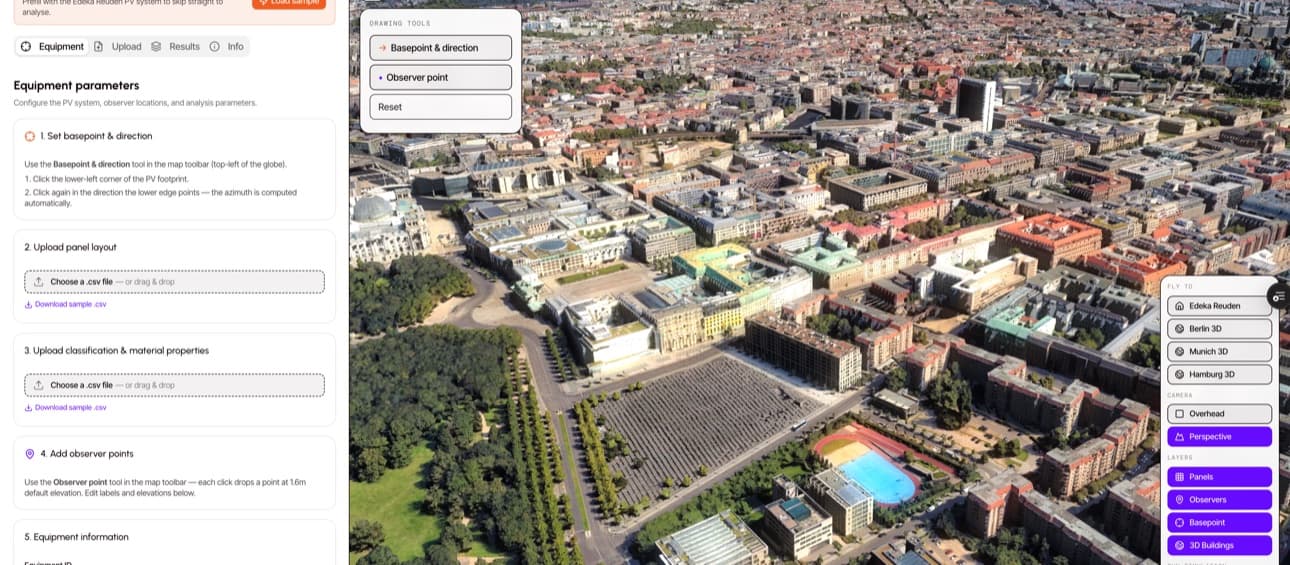
The current generation of assessment tools moves the visualisation into 3D. The site is rendered on a real-world globe with accurate terrain and surrounding buildings. The sun moves across the sky based on the actual date and location. Shadows fall where shadows would fall. The observer sees the panels and the reflected sun direction as a physical scene, not as an abstract chart.
This matters for two reasons:
- Trust. A planning officer or neighbour who can see the simulation believes the result. The visual evidence and the numerical result are the same thing.
- Iteration. When a site fails the thresholds, the team needs to test mitigation options quickly. Moving panel tilts in a 3D environment is much faster than re-running a 2D analysis from scratch.
The interactive 3D approach is becoming the practical standard for non-trivial sites, particularly those near residential areas or with complex terrain.
How to Submit a Compliant Assessment
If you are preparing a PV permit submission in Germany, the typical workflow:
- Commission the assessment early. A glare assessment can take weeks if data preparation is needed. Starting it after the planning application is filed risks delaying approval.
- Provide accurate panel geometry. The assessment depends on exact panel positions, tilt angles, azimuths, and material reflectivity. Approximations at this stage propagate into the result.
- Identify all observers up front. Residential windows, road users, and aviation lines of sight. Missing observers is the most common reason a submission is sent back for revision.
- Include the 3D view alongside the numbers. A modern assessment report contains the LAI-compliant tables and the visual simulation. Planning authorities increasingly expect both.
- Plan for mitigation iteration. If the first analysis fails, allow time to test design changes and re-run the assessment.
Once the report is complete, it is submitted as part of the standard permit application (Bauantrag) package. The authority reviews it against the LAI thresholds and either approves the project, requests mitigation, or invites the affected neighbours to comment.
Frequently Asked Questions
Does the LAI guidance have legal force? The LAI guidance is not law in itself, but it is the standard reference used by state and local authorities to apply the BImSchG. Courts have repeatedly upheld its thresholds. In practice, a glare assessment that meets the LAI criteria is treated as compliant.
What if the site is in a federal state with its own guidance? Some states publish their own circulars elaborating on the LAI thresholds, but the core methodology and limits are consistent across Germany. The assessment approach is the same; only the local submission package may differ.
How long does a glare assessment take? A simple rooftop installation can be assessed in days. A larger ground-mounted PV system with complex terrain or many observers takes one to three weeks, depending on data preparation. Modern tooling has shortened these timelines significantly.
Are anti-reflective coatings enough to skip the assessment? No. Modern PV panels do have lower specular reflectivity than older designs, but they still produce measurable glare under certain sun angles. The assessment is required regardless of coating, though the coating's optical properties feed into the result.
Does the same approach apply outside Germany? The technical methodology — ray-tracing observers and reflected sun positions — applies anywhere. Many European countries have adopted comparable thresholds, often inspired by the LAI numbers. The specific legal framework differs, but the assessment work is largely portable.
In Summary
A glare assessment under BImSchG is not just a paperwork exercise. It is a technical demonstration that a proposed PV installation will not create hazardous glare for neighbours, road users, or pilots. The LAI thresholds are clear, the methodology is well established, and the cost of doing it well is small relative to the cost of a permit delay.
The shift to interactive 3D assessment is the most significant change in this space in years. It turns a static technical document into something a non-expert can evaluate at a glance — which is what the planning process actually needs.
If you are preparing a PV project that needs a glare assessment, see how we built our solar glare assessment app on CesiumJS, or get in touch to discuss your project.