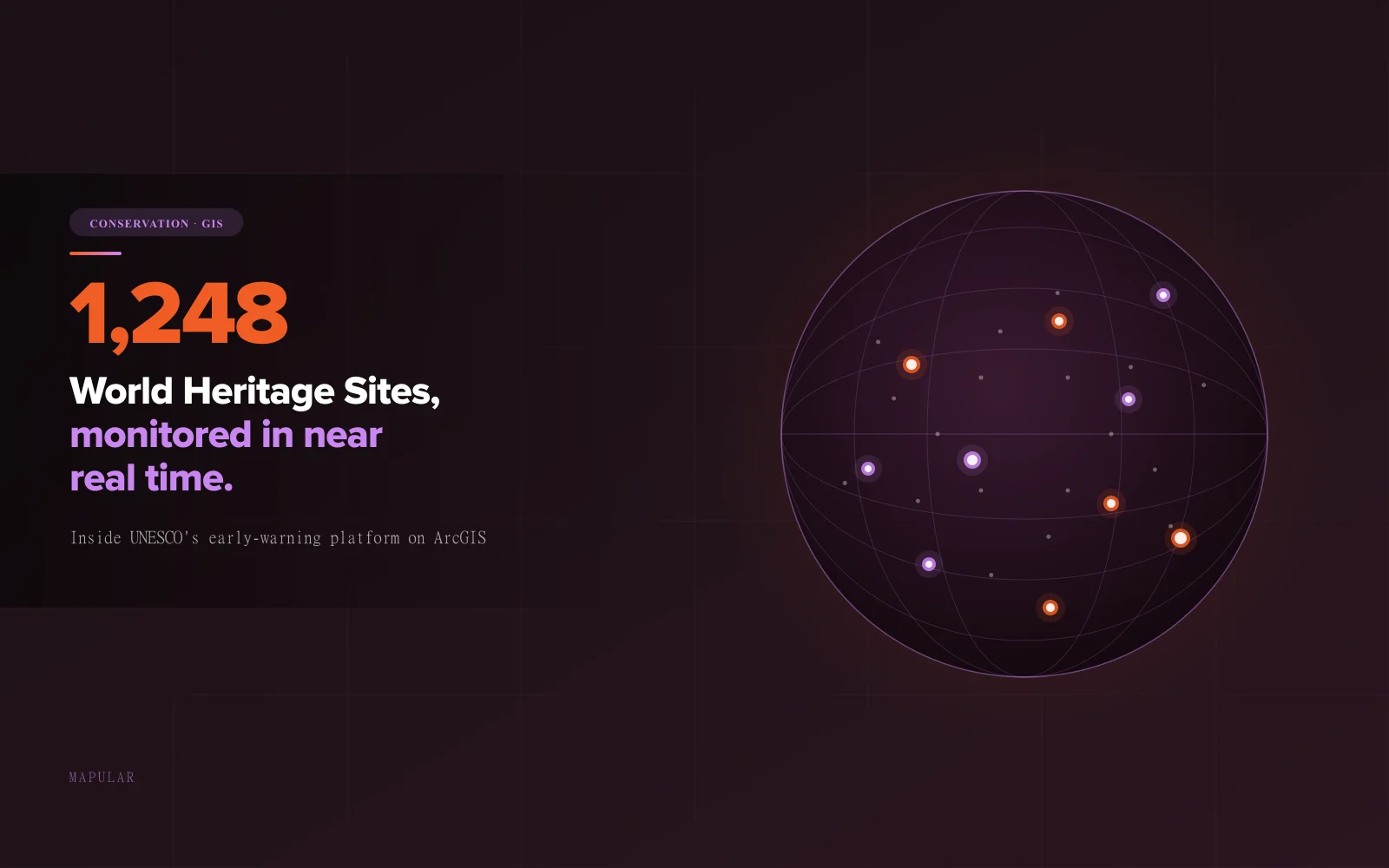
The UNESCO World Heritage List protects 1,248 places across 170 countries. Machu Picchu. The Great Barrier Reef. Cologne Cathedral. The Lavaux vineyard terraces. Places so different in climate, geography, and cultural context that a single management approach simply cannot work.
And yet the threats to those sites (wildfires, earthquakes, floods, coral bleaching, deforestation) do not respect the boundaries that separate Cultural from Natural sites, or one country's jurisdiction from another's.
So how do you keep watch over 1,248 properties with one small team?
That was the question UNESCO was solving when they partnered with Esri and with Mapular, an Esri Germany partner, to extend the UNESCO Sites Navigator into a living monitoring platform.
The opportunity: global scale, local consequences
World Heritage inscription happens once. Protecting a site happens every day.
New hazard datasets become available every year, from higher-resolution satellite feeds to real-time disaster networks like USGS, GDACS, NASA FIRMS, NOAA, and Global Forest Watch. Each of them is useful on its own. The value multiplies when they come together in one place, aligned to the same site geometries, at the same cadence, inside a platform a conservation team can navigate without writing code.
That is the opportunity the Sites Navigator was built to capture.
Three constraints shaped the brief:
- Global coverage, site-level precision. A wildfire near a natural site is not the same as a wildfire near a stone monument. The system must reflect that.
- Low-code maintainability. UNESCO's GIS team are conservation and heritage specialists first. They needed a platform their existing staff could own and extend, without developing.
- Transparent science. Alerts had to be explainable: why did this site flag, what data did it come from, what threshold was crossed? Over-alerting erodes the credibility of the platform itself.
The solution: the UNESCO Sites Navigator, extended
UNESCO and Esri had already built the foundation of the Sites Navigator: a unified map pulling World Heritage Sites, Biosphere Reserves, and Global Geoparks into a single interactive view.
Mapular joined to build the environmental risk and alert engine: the part that turns the map from a reference tool into a daily operational instrument.
Three pieces came together:
- A harmonized sites layer that resolves point-based and polygon-based site records into one consistent geometry set.
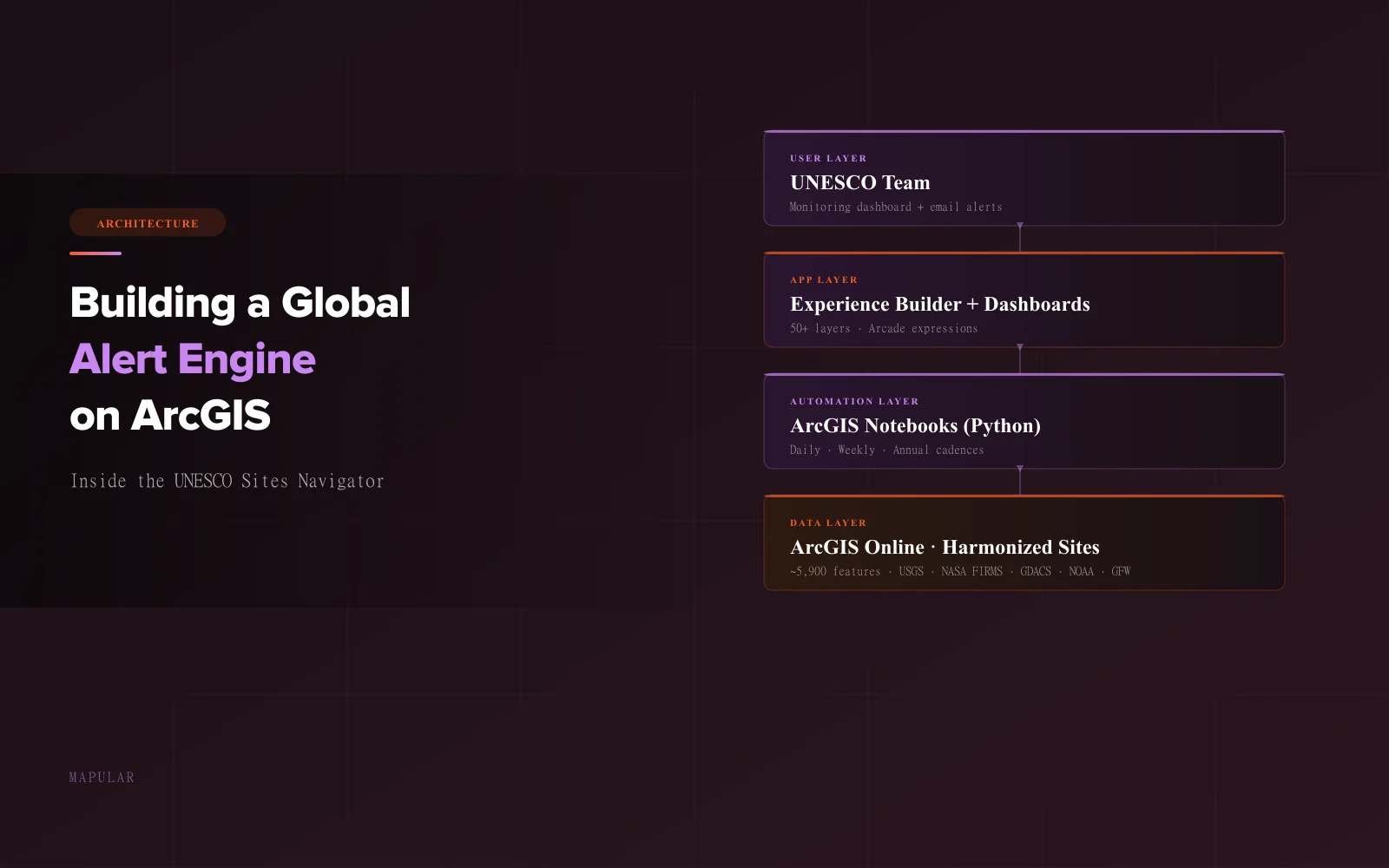
- An automated alert system that runs scheduled analyses against live hazard feeds and flags each site when attention is warranted.
- A dedicated monitoring dashboard and advanced map application built on Esri's out-of-the-box tools so UNESCO's team can maintain everything themselves.
You can explore the public UNESCO World Heritage GIS page to see the platform in context.
From raw hazard feeds to actionable alerts
The alert engine ingests from the organizations whose job it is to watch the planet:
- NASA FIRMS for active fires
- USGS for earthquakes
- GDACS (the UN/European Commission joint system) for tsunami advisories
- NOAA Coral Reef Watch for coral bleaching conditions
- Global Forest Watch for vegetation disturbance and tree cover loss
- WRI Aqueduct for water risk, flood risk, drought, and water stress
Each feed is interpreted through thresholds UNESCO's scientific team defined. The system does not guess. Events below the defined severity are ignored. Events above it, within a relevant distance of a site, become an alert.
The principle is simple and important: the system flags situations that warrant attention. UNESCO's team, with local context and scientific expertise, decides what to do with them.
Why ecological relevance matters
Not every hazard threatens every site in the same way.
Coral bleaching is a catastrophe for the Great Barrier Reef and irrelevant for the Cologne Cathedral. So the platform only evaluates bleaching for Natural and Mixed sites.
A wildfire close to a stone monument is a structural risk for the monument itself. A wildfire at a similar distance from a forest reserve is a risk to the ecosystem that defines the reserve's value. The platform reflects that difference by applying the appropriate buffer distance for each site category.
Decisions like these were not implementation details. They were design choices that turned a generic spatial analysis into a tool that makes sense to conservation scientists.
Early warning in practice
On a quiet Tuesday, the notebook runs at its scheduled time. It pulls that day's earthquake list from USGS, fires from NASA FIRMS, and tsunami advisories from GDACS. It determines how far each event could reasonably affect a site and runs a server-side spatial filter against the harmonized sites layer.
If any site is affected, its alert flag flips to Yes in the production layer. The monitoring dashboard updates automatically. An email goes out to the UNESCO team, grouped by hazard type, with site names and the specific conditions that triggered the alert.
On a noisy Tuesday (a Pacific tsunami warning, a fire season in the Mediterranean, a coral bleaching event in the Caribbean at the same time) the same engine runs. The pattern is the same. The value scales.
Why out-of-the-box was non-negotiable
This is the part that matters most for other nonprofits thinking about similar investments.
Everything Mapular built sits on Esri's standard platform: ArcGIS Online for hosting, ArcGIS Experience Builder for the web application, ArcGIS Dashboards for monitoring, ArcGIS Notebooks for the scheduled automation, Arcade for pop-up logic.
No custom backend. No bespoke front-end framework. No services that only one vendor can keep alive.
That matters because nonprofit technology that depends on a specific consulting relationship is fragile. The moment the contract ends or the consultant leaves, the system freezes. UNESCO insisted from day one that everything be maintainable by their in-house GIS team. That constraint shaped every architectural decision.
Lessons for other nonprofits
A few patterns from this engagement translate directly to other global nonprofit monitoring programs:
-
Design for team autonomy, not for the consultant. Out-of-the-box tools are slower to customize than bespoke code, but they last longer and cost less over the decade that matters.
-
Let scientific expertise drive thresholds, not software defaults. The value of an alert is a function of the thresholds behind it. Generic "anomaly detection" is not useful for conservation work.
-
Separate the hazard from the interpretation. The platform flags. The humans decide. This keeps trust intact over time, even as data sources change.
-
Harmonize your entities first, then layer analytics on top. The hardest part of the UNESCO engagement was not the alerting logic, it was producing one consistent geometry layer for every site. Analytics are only as good as the spatial foundation beneath them.
Built to grow with the mission
The Sites Navigator was designed to keep evolving alongside UNESCO's wider conservation work. The same foundations that power monitoring of World Heritage Sites today can be extended to other UNESCO designations such as Biosphere Reserves and Global Geoparks, as well as to new data sources as they become available.
That flexibility, more than any single alert, is the outcome we are most proud of.
Looking to build something similar?
Mapular helps nonprofit and conservation organizations plan, build, and maintain monitoring platforms on the ArcGIS ecosystem. If you are thinking about an early-warning system for your own program, we would love to hear what you are protecting and how we can help.