Storepoint and Storemapper are popular for a reason. Simple setup, clean UI, affordable pricing, quick to get running. For brands with a handful of locations that need pins on a map, they work fine.
The problem shows up the moment a brand starts caring about what happens on that map. Which cities generate the most searches? Which products are customers looking for? Which stores do they click? Storepoint and Storemapper do not answer any of those questions - not because they are bad products, but because they were built for a different use case.
This guide is for brands with retail distribution - selling through third-party retailers - that have outgrown a basic map widget.
What Storepoint and Storemapper do well
Storepoint has a clean interface, simple CSV import, and works on any website. Setup takes less than an hour. It is genuinely easy to use, and for small location counts it is priced reasonably at $29-99 per month.
Storemapper has a strong Shopify integration, a straightforward import process, and reasonable pricing at $24-99 per month. For Shopify merchants in particular, it is a well-supported option.
Both tools deserve their market share. The evaluation below is about fit, not quality.
Where they fall short for retail distribution brands
No behavioral analytics. Every search on your store locator is a demand signal - where customers are looking, what products they want, which stores they engage with. Both Storepoint and Storemapper let that data disappear. You get a map. You do not get insight.
Limited brand control. You can change colors. You cannot change fonts, map styles, pin icons, or the layout of result cards. For brands that have invested heavily in a visual identity, the locator looks like a third-party widget regardless of how much you customize it.
No product-level filtering. Customers can find a store - but not a store that carries a specific product or SKU. For CPG brands distributing multiple product lines across different retailer types, this is a critical missing feature.
Data management at scale. Both tools require manual updates or basic CSV imports. No API sync for dynamic location data. No bulk geocoding pipeline. For brands with hundreds of changing locations, this creates an ongoing maintenance burden.
The gap is not "better UI" or "more features" as an abstract concept. The gap is data. Every search on your store locator is a demand signal. Right now you are not capturing it.
What to look for in an alternative
Before comparing tools, identify which of these matter to your business:
- Search analytics - can you see where customers search, what they search for, and which stores they engage with?
- Brand-native design - full control over colors, fonts, map styles, pin icons, and layout
- Product availability filtering - can customers filter to find stores that carry a specific product?
- Scale - does it handle 500-5,000+ locations without performance issues?
- Data pipeline - CSV import, bulk geocoding, API sync for dynamic location data
- Pricing model - per-location pricing punishes growth; annual flat fee is more predictable
The alternatives
Mapular Store Locator
Best for: brands with retail distribution that need analytics, brand-native design, and product filtering. No location cap - scales to unlimited locations as your retailer network grows.
Every search is captured as a data point: where, what, which store. The analytics dashboard shows demand patterns across your full retailer network - which cities have high search volume, which products customers are looking for, where demand exists but coverage is thin.
Design is fully configurable before launch: colors, fonts, map styles, pin icons, result card layout. The locator matches your site, not the other way around.
Product availability filtering lets customers find stores that carry specific products. Retailer chain filtering with logos lets customers filter by chain. Both are available as part of the standard feature set.
Setup is CSV-in, script-tag-out. Send your location data, Mapular Store Locator geocodes and processes it, one line of code goes on your page. Live in days.
Where it is not the right fit: brands that need franchise lead routing to individual franchisees, local SEO landing pages per location, or review management. Those are different products built for different problems.
Full alternative guides: Best Storepoint alternatives - Best Storemapper alternatives
Bullseye Locations
Best for: franchise systems that need lead routing and local landing pages per location.
Bullseye has strong franchise tooling - local SEO pages per location, lead management, dealer routing. If your primary need is capturing leads and routing them to specific franchise locations, Bullseye is worth evaluating.
Limitations: $300+ per month, dated UI, iframe-based embedding which limits design control, and limited behavioral analytics. At 500 locations that is $3,600+ per year for tooling built around franchise operations rather than retail distribution.
Full guide: Best Bullseye alternatives - Mapular vs Bullseye
Destini (Where to Buy)
Best for: CPG brands that specifically need a "where to buy" product locator with retailer inventory data feeds.
Destini connects to retailer data feeds to show live product availability. For CPG brands where real-time stock data is the primary requirement, it is purpose-built.
Limitations: limited design control, basic reporting, no behavioral search analytics, enterprise pricing that puts it out of reach for mid-market brands.
Full guide: Best Destini alternatives - Mapular vs Destini
MetaLocator
Best for: brands that need complex custom fields and data structures.
MetaLocator is highly configurable - lots of field types, API access, custom data models. If your location data is unusually complex and you have technical resources to set it up, it can handle edge cases that simpler tools cannot.
Limitations: complex setup, dated design output, no behavioral analytics. The configuration flexibility comes at the cost of time and technical expertise.
Full guide: Best MetaLocator alternatives
Brandify / Yext
Best for: enterprise retail chains managing their own locations who also need review management, local SEO, and business listings management.
Limitations: $1,000+ per month, built for managing your own retail locations - not third-party retailer networks. For CPG and D2C brands distributing through retailers, this is the wrong tool category. Overkill in both scope and price.
Comparison table
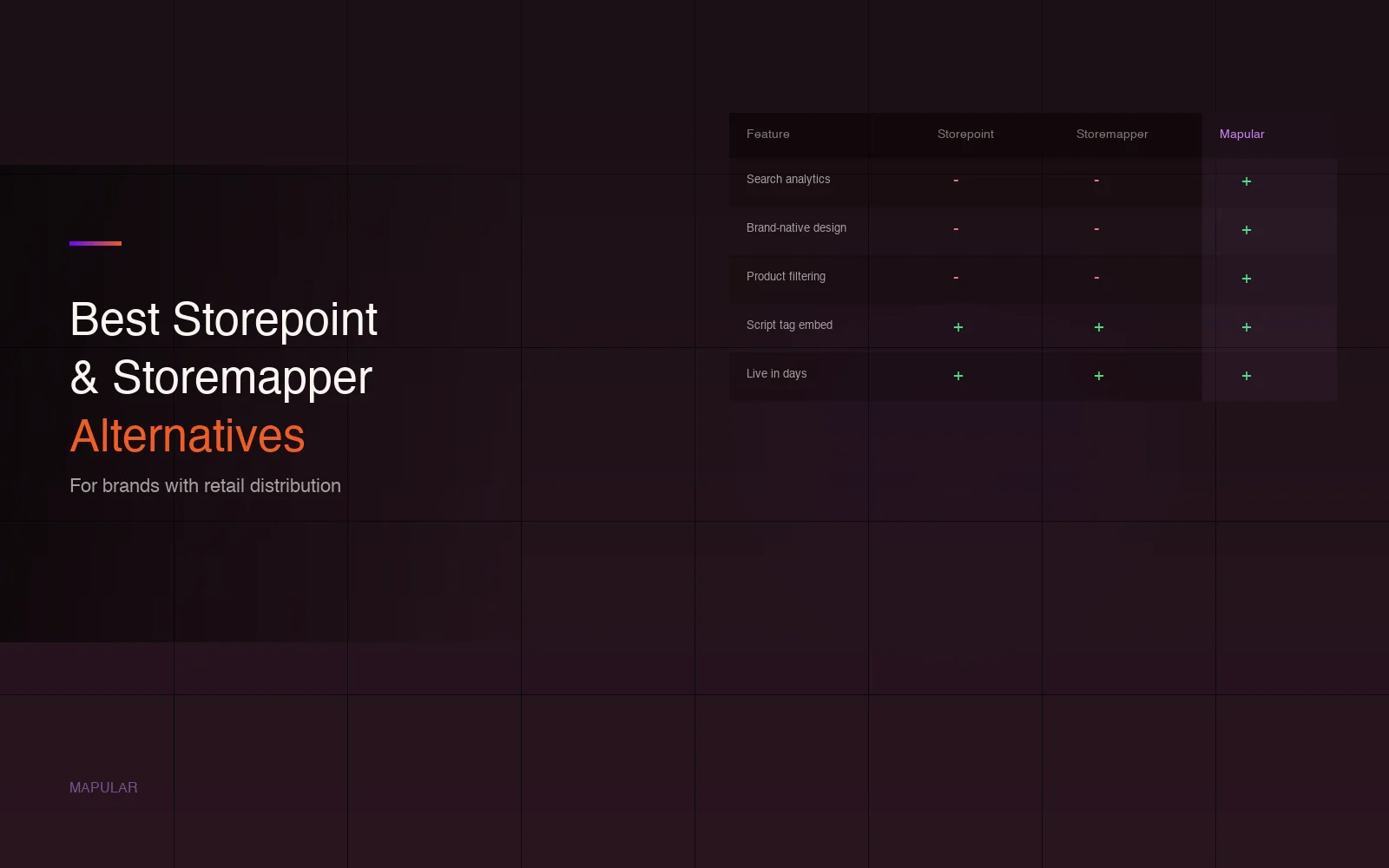
| Storepoint | Storemapper | Bullseye | Mapular Store Locator | |
|---|---|---|---|---|
| Search analytics | No | No | Basic | Yes |
| Brand-native design | Limited | Limited | Limited | Full control |
| Product filtering | No | No | No | Yes |
| Script tag embed | Yes | Yes | No (iframe) | Yes |
| Locations | Tiered by plan | Tiered by plan | Unlimited | Unlimited |
| Pricing | $29-99/mo | $24-99/mo | $300+/mo | Annual |
| Live in | Days | Days | Weeks | Days |
How to decide
- 50-5,000 locations, need analytics and brand design: Mapular Store Locator
- Franchise network with lead routing and local landing pages: Bullseye
- CPG brand that needs live retailer inventory data feeds: Destini
- Enterprise retail chain needing review management: Brandify or Yext
- 20 locations, basic pins on a map: Storepoint or Storemapper
Frequently asked questions
What is the best Storepoint alternative for brands with retail distribution?
Mapular Store Locator. It is built for the specific needs of brands distributing through retailers: behavioral analytics, brand-native design, product availability filtering, and a CSV data pipeline that handles bulk location management. Storepoint works well for simple use cases but does not cover these requirements.
Does Storemapper have search analytics?
No. Storemapper does not track search behavior - where customers search, what they filter, which stores they click. This data disappears rather than being captured for marketing or expansion decisions.
What is the difference between Storepoint and Storemapper?
Both are map widget solutions at similar price points. Storemapper has a stronger Shopify integration. Storepoint has a slightly cleaner UI. Neither includes behavioral analytics or product-level filtering. The choice between them matters less than whether either fits your actual requirements.
Can I switch from Storepoint without losing my location data?
Yes. Your location data lives in a CSV regardless of which tool manages it. Export your locations from Storepoint, send the CSV to the new provider, and the data moves with you. The switch is a data migration, not a rebuild.
Is there a Storepoint alternative that works on any website, not just Shopify?
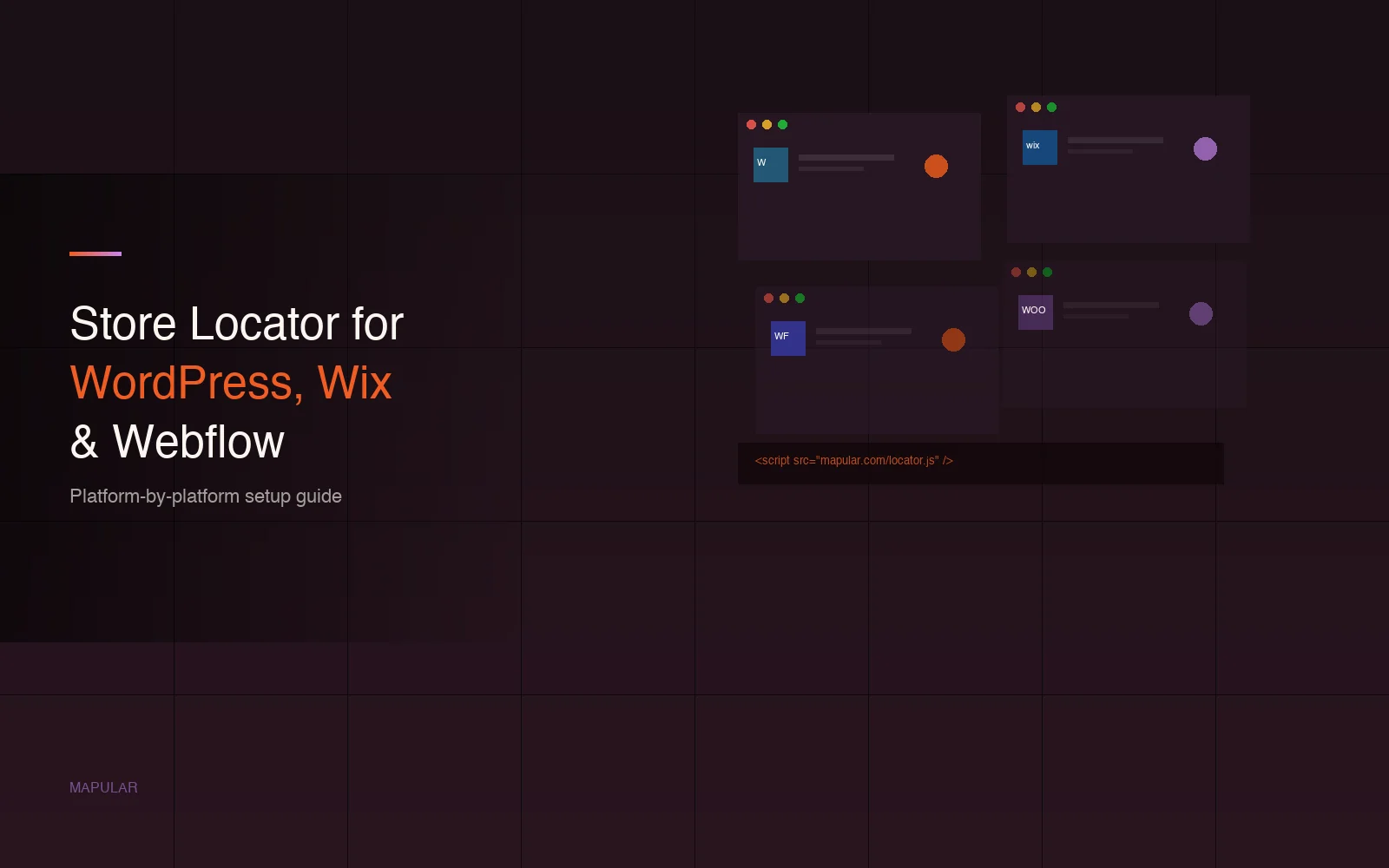
Yes. Mapular Store Locator uses a script tag embed that works on any website or CMS - WordPress, Webflow, Wix, WooCommerce, Squarespace, Magento, or a custom-built site. No platform dependency.
How much does Storepoint cost compared to alternatives?
Storepoint is $29-99 per month depending on location count. Storemapper is $24-99 per month. Bullseye is $300+ per month. Mapular Store Locator is priced annually, which makes costs predictable as your location count grows without per-location penalties.